

Part of a series on the enduring global brands we own.
“It’s deemed outrageously expensive, it’s insulting to existing owners and perhaps most damning of all – it looks like a Nissan Leaf” – CNN Business, 28 May 2026
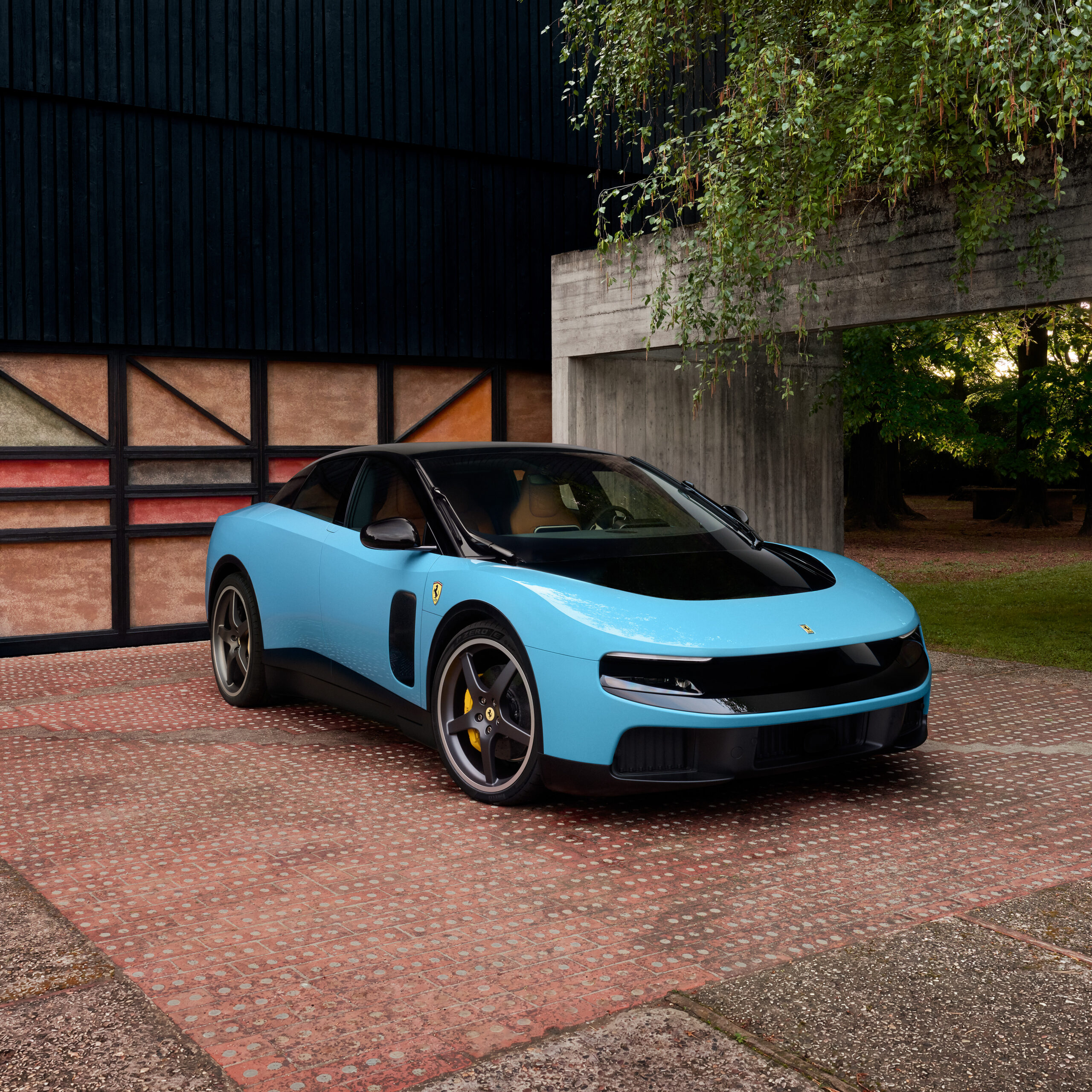
On 25 May, Ferrari unveiled the Luce in Rome: its first fully electric car, its first five-seater, four doors, €550,000, shaped with the help of Jony Ive’s LoveFrom.
The reception was among the harshest a modern luxury launch has had, with shares falling almost 8%. Dezeen asked why everyone hated it. The Verge called it possibly the most universally disliked Ferrari ever unveiled. Ferrari’s own former chairman suggested they at least take the prancing horse off. The spec sheet offered no cover: a Mercedes-AMG electric four-door gives you more range for €154,700 and more power than the Luce for €196,350, and a Porsche Taycan starts at about €101,500. On every measure the luxury car market habitually reaches for — design consensus, comparative specification, price per horsepower — the car was written off.
In June, with the criticism still at its loudest, we spoke with Ferrari’s investor relations team. We have followed the company since its 2015 IPO and hold it in the portfolio. We observed an intensely emotional reaction, concentrated on social media, while journalists and existing clientele had been markedly more constructive and were waiting on in-person viewings before forming a view. More importantly, the Luce was never conceived as a replacement for anything. It is an addition to the portfolio, aimed deliberately at a different, often new, set of clients. On pricing, the company was explicit that the €550,000 is not an attempt to match competitors on technical specification but a reflection of innovation, exclusivity and the driving experience. Setting the number was described to us as “art and science”, combining financial modelling, prototype test drives and comparison against both past Ferraris and rival cars. Ferrari also declined to give a volume target, and said plainly that it would manage supply below demand to preserve scarcity. Taken together, the company is intentionally trying to bolster its luxury status, as opposed to bringing out premium competitor. This strategy is consistent with some of the most aspirational and sought after brands in the world – and over time.
Despite the hysteria and media frenzy, critically, two months later the order book began to tell a different story. Management positively voiced their support and on the Q2 call said they were “very much satisfied” with Luce orders, that they were arriving in line with plan, and that they came from a satisfactory range of both repeat clients and buyers who had “never bought a Ferrari in their life.” This outcome was in complete contrasts to what the public reaction had implied.
The full-year target for the model had already been met and the wider order book now covers the whole of 2027 as well. That statement carries more weight once you understand how closely the company watches demand. In June we were walked through the methodology: speed and quantity of order intake by model, cancellation rates and the reasons behind them, residual values tracked both model by model and across the fleet, dealer feedback and direct client interviews. At roughly 13,000 deliveries a year, Ferrari has an actual human relationship with a meaningful share of its buyers. Nor is the framework decorative, and the company described cutting supply into the UK after residual values weakened and demand decelerated. A management team with that granularity, supported by data, relationships, and a demonstrated willingness to act on it, does not describe itself as satisfied casually.
We would caution against reading too much into the economics of the car itself. The analysis suggests that Luce will account for around 600 units a year against group shipments of roughly 13,500, so it will never move the P&L on its own. Nonetheless, that is rather the point. What this episode measures is not the strength of one vehicle but of the franchise around it. The same quarter showed that franchise working: although shipments fell, revenue rose 11% at constant currency, personalisation ran above 20% of car and parts revenues, and full-year guidance went up. Ferrari makes its money from what buyers choose to add, and from a queue they are willing to wait years to join, not only from how many cars leave Maranello on a quarterly basis. Two details from our June conversation capture how deliberately that is managed. Clients can keep changing their personalisation specification until three to four months before delivery, which sounds like an operational inconvenience and is in fact a revenue mechanism — the longer the window stays open, the more gets added. And Ferrari reserves the right to refuse a configuration it considers offensive to the brand, offering the client an alternative instead. A company that turns down paid work to protect an aesthetic is telling you exactly where its asset sits.
That is what brand power actually is, and it is persistently underpriced because it does not sit in a spec sheet or a financial model. It is the licence to be wrong occasionally without being punished commercially; the ability to price at nearly three times the nearest comparable and still ration supply; the customer who buys the badge and the belonging and treats the object as the means of access rather than the end. It is also, on the evidence of that June call, something the company measures and defends with far more discipline than outsiders assume. Since its foundation a century ago in 1929, Ferrari has proven to be incredibly resilient, surviving and thriving through a world war, recessions, and now, the energy transition. Its ability to maintain the strictest standards of luxury and remain an enduring symbol of high standards has given it the kind of pull that only a select handful of brands have, meaning poor product receptions say far less about commercial outcomes than markets often assume. Ferrari itself proved it before, with a Purosangue that was mocked at reveal in 2022 and then sold out. The lesson generalises beyond both Luce and Ferrari itself. When the next consumer launch is written off on the reviews, the question worth asking is not whether the initial product is good, but whether the brand is strong enough not to need it to be.