

There is robust debate over whether AI is in a “bubble”: whether today’s funding, infrastructure investment and corporate spending plans can be sustained—and, ultimately, whether the returns will justify them.
These are important questions, but many of the debates focus heavily on capital expenditure and valuation, while overlooking a more basic question:
Are people and businesses finding AI useful enough to keep using—and spending on it?
From what we see, the answer is increasingly clear.
We firmly believe we are in the early stages of what will become an exceptionally large and durable demand cycle.
Across our global research team, we monitor consumer activity and spending data across categories and countries. AI is, by some distance, the fastest-growing area of engagement. Yet the most important observation is not simply the growth rate: penetration and spending remain modest for the majority of users and businesses.
The gap between experimentation and deep operational deployment remains very wide.
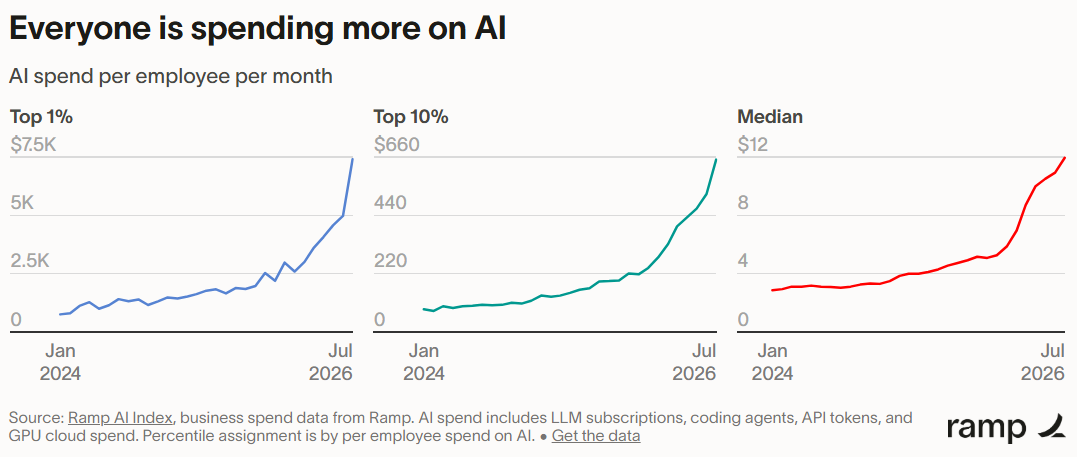
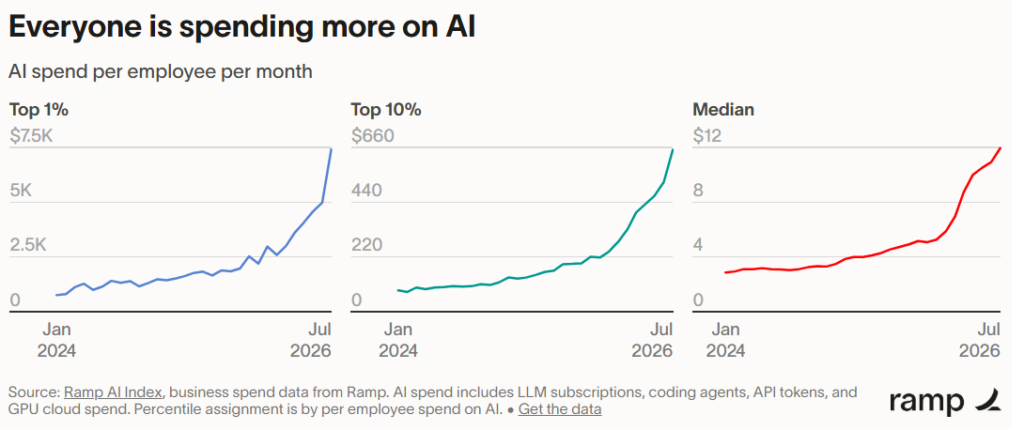
Recent Ramp AI Index data illustrates the point. The median business spent approximately $12 per employee per month on AI in July 2026. But the top 10% spent around $650, and the top 1% roughly $7,400 per employee.
This is not a typical software-spend distribution.
It suggests that most organisations are still using AI at the edge of their existing workflow: summarising documents, drafting emails or conducting research. Critically, at this price point, it is highly likely that these AI workflows are siloed, with significant room for improvement.
A smaller—and rapidly growing—group is moving further. These firms are embedding AI into customer service, compliance, underwriting, claims, procurement, sales, software development, logistics, and internal operations. Their AI budgets are not just buying employee licences. They are funding integrations, proprietary-data access, model inference, governance, workflow redesign and human oversight. They are most structured, coordinated and valuable.
That distinction matters.
The economic value of AI will not be determined by how many employees have access to a chatbot. It will be determined by whether businesses can use AI to make decisions faster, serve customers more effectively, reduce operational errors, lower cost-to-serve and increase output per employee. Much of this success comes down to how a business approaches the integration of data and AI across what they do.
Our conversations with consumers and companies reinforce this view. The examples are often immediately tangible. At the basic end, people save time summarising long documents, extracting information, drafting communications or analysing data. At the more advanced end, teams are using AI to develop strategic plans, build product roadmaps, automate research, prepare client materials and redesign internal processes.
The range of engagement remains enormous. Some management teams speak about AI with real urgency, backed by budgets and implementation plans. Others remain mildly interested, experimenting at the periphery while waiting for clearer proof points. People choose how they use and embrace AI.
This divergence is familiar.
It resembles the early development of e-commerce. Many incumbent retailers initially regarded it as a niche channel, or simply an extension of their existing business. Some hesitated to invest, delayed adaptation, or dismissed the change altogether. A number did not survive. The businesses that recognised the shift, invested ahead of the curve and rebuilt around the new consumer behaviour were often rewarded.
AI will likely follow a similar path—not in every sector at the same speed, but across a far broader set of work.
The addressable opportunity is substantial. Services account for roughly 65% of global GDP, representing approximately $60–70 trillion of economic activity. By comparison, software expenditure is only around 2% of GDP. If AI delivers even a fraction of its promise—improving productivity, enabling better decisions, accelerating development cycles and automating repeatable work—we expect software, compute and AI-enabled services to take a materially larger share of the value created across the economy.
That spend will show up in many forms:
This creates a positive domino effect. Higher adoption drives new products and better user experiences. Better products create greater utility and more demand. Greater demand supports investment in infrastructure, software, devices, data and specialised services.
Importantly, this need not require every AI investment made today to succeed. There will be excess capacity, weak business models and disappointing applications—as there were in prior technology cycles. But that is different from saying that the underlying demand is artificial.
The core trend is real: people and businesses are already finding ways to use AI to improve their personal and professional lives.
The question is no longer whether AI will be used.
The more consequential question is which companies will move from adding AI to existing work—and which will redesign their products, processes and operating models around it.
We believe the adoption, spending and economic impact of AI, across sectors, have much further to run.
What an exciting time to be alive!
Jack