


The headlines kept coming—US GDP surprised on the upside and stocks chopped around during a seasonally weak period. Yet beneath the noise, change accelerated as deals were struck, restructurings announced, and our outlook for how we shop, work, eat, and play evolved. Warehouse clubs are redefining membership value, coffee giants are rethinking their store networks, and AI is promising an economic impact on the scale of entire nations—the consumer landscape is changing rapidly.
AI Investment Reality: Beyond the Bubble Debate
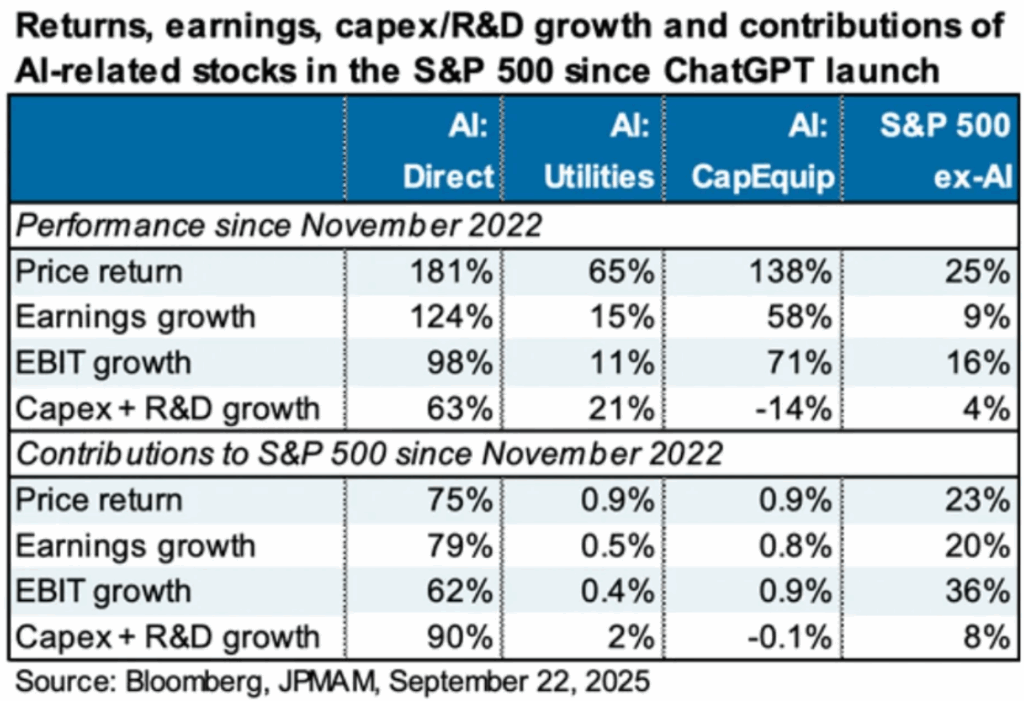
While AI-linked companies have driven roughly 75% of S&P 500 returns since ChatGPT’s late 2022 launch, this week’s projection from Saudi Arabia’s Data & AI Authority offers perspective worth considering: AI contributing ~$20 trillion to the global economy by 2030—equivalent to China’s entire GDP today.
Though such figures strain comprehension, our direct experience embedding AI across our investment processes has influenced our conviction that adoption will continue beyond most investors’ current understanding. The economic value isn’t theoretical—agentic systems executing autonomous decisions, generative AI driving eightfold investment increases since 2022, and physical AI merging intelligence with robotics represent entirely new categories of value creation.
Whether tomorrow’s winners match today’s leaders remains the critical question, but Infusive’s analysis suggesting 60% of the services economy could be enhanced as AI knowledge costs plummet provides a framework for thinking about scale. The bubble debate will continue, but the underlying transformation appears irreversible.
When the Membership Model Meets Digital Reality
After two decades watching consumer companies navigate disruption, I find myself genuinely intrigued by what Costco accomplished this quarter. Yes, they beat estimates with $5.87 EPS versus $5.81 expected, but the real story lies in three converging trends that suggest this isn’t your grandfather’s warehouse club anymore.
The digital transformation is accelerating beyond anyone’s expectations**.** E-commerce sales of $19.6 billion grew 13.6%—nearly double the company’s overall 8% growth rate. What caught my attention wasn’t just the 27% surge in website traffic, but the sophistication emerging beneath the surface: gold and jewelry performing strongly online, enhanced personalization driving supplier engagement, and “digitally enabled sales” reaching $27 billion when you include same-day partnerships. This isn’t incremental improvement; it’s structural evolution of the membership value proposition.
The membership dynamics reveal a generational handoff in progress. CFO Gary Millerchip’s observation that “almost half of our new member sign-ups are now under the age of 40” initially masked as a renewal rate concern (down to 92.3%) actually represents the most bullish long-term signal imaginable. These younger cohorts are discovering Costco through digital channels, and while their initial renewal patterns differ, the Executive membership tier continues to demonstrate remarkable stickiness—driving 73% of worldwide sales despite representing less than half of members. The company’s confidence in addressing digital engagement through “targeted communications” suggests management understands this transition.
Perhaps most telling is management’s aggressive expansion stance: 35 new warehouses in fiscal 2026, the most ambitious growth target in years**.** When CEO Ron Vachris speaks of “significant opportunities both domestically and internationally” while CFO Millerchip indicates capex will “outpace sales growth,” they’re signaling something rare in today’s cautious retail environment—genuine unit economic confidence. The 1% weekly sales lift from executive hours alone validates their ability to create tangible member value through operational innovation.
The Chipotle Playbook Meets Coffee Reality
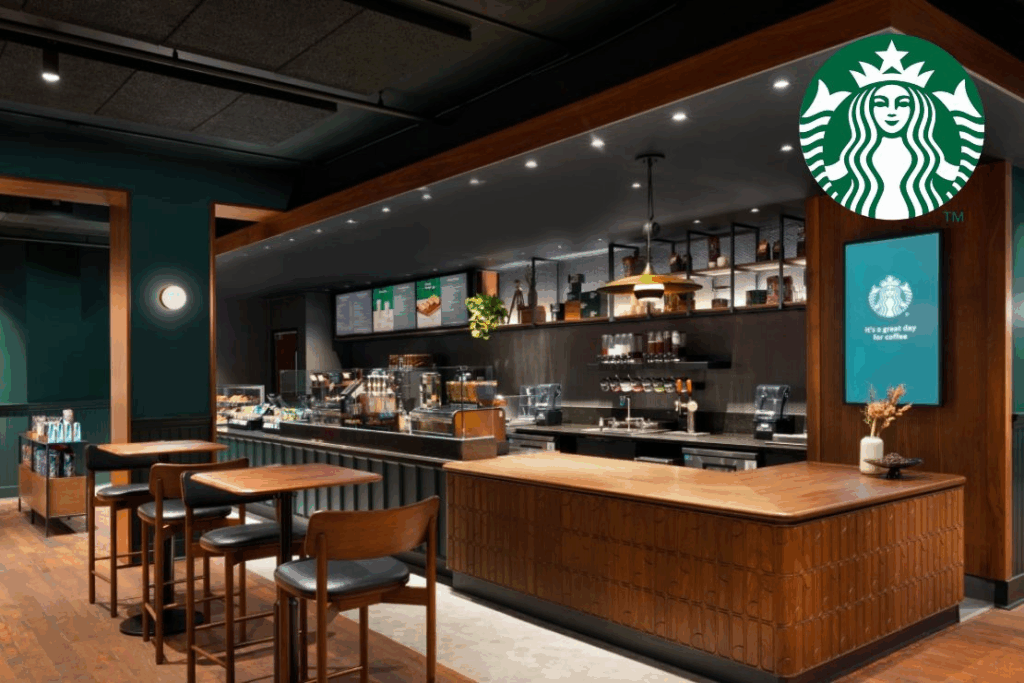
Brian Niccol’s Thursday restructuring announcement—closing underperforming stores and eliminating 900 non-retail positions—represents the most significant downsizing in Starbucks‘ recent history. But having watched Niccol’s transformation at Chipotle, I’m more curious about what this signals for the broader coffeehouse category than concerned about near-term disruption.
The structural headwinds are undeniable: six consecutive quarters of declining North American same-store sales, remote work permanently altering away-from-home consumption patterns, and Gen Z’s preference for ready-to-drink over traditional coffeehouse experiences. Yet Niccol’s letter to employees reveals strategic thinking beyond simple cost-cutting—closing locations “unable to create the physical environment our customers expect” while investing savings into viable store improvements suggests portfolio optimization rather than retreat.
New Starbucks store development
The simultaneous Chinese divestiture (bids expected October) adds complexity, as market share has halved since 2019 amid local competition. The market debate around Niccol’s multi-year turnaround potential is robust, but his track record of operational excellence in challenged categories deserves measured optimism. Sometimes the deepest restructuring creates the clearest path forward.
The Infusive Team