


In a 24 hour news cycle and raging debate on social media, it can be tempting to form views about the state of the economy and consumer. Every few months, companies clarify this speculation and in recent days, we have heard from some of the largest consumer companies in the US and China. These insights suggest what many of us feel: Shoppers aren’t closing their wallets, but they are choosing carefully, stretching their money further, and rewarding the retailers who make them feel both smart and valued.
At Infusive, as a consumer focused asset manager, we analyse results closely and amplify our process using AI. Beyond the numbers, we track how companies adapt — in tone, in strategy, in technology. What emerges is a global story: value continues to win, discretion spend is mixed or deferred, and technology is quietly redrawing so much of the map.
Housing: Chipping Away
Housing is one of the most hotly debated consumer categories — affordability is stretched, mortgage activity is sluggish, and new starts are uneven (in many developed countries). President Trump has been critical of the Federal Reserve and the level of interest rates. If he got his way. it would almost certainly provide a boost to the $50 trillion housing market.
We’ve heard from market leaders in recent days, Home Depot and Lowes. The headline is that big remodels remain on hold with mortgage rates near 7%, but maintenance projects continue to support demand. The Chair and CEO of Home Depot said: ”The momentum that began in the back half of last year continued throughout the first half as customers engaged more broadly in smaller home improvement projects.”
People are taking care of what they have rather than spending up.
Whilst the market is focused on the cyclicality, we were interested by what companies said about AI and innovation.
Lowes announced an acquisition of Foundation Building Materials (FBM) for $8.8 billion. CEO Marvin Ellison noted.
“Their AI-driven blueprint takeoff technology, is the best I’ve ever seen. We think we can immediately plug that into every Pro desk in our 1,750 plus stores.”
We met with the Lowes executive team in 2024 at their Investor Day and they were excited about the potential of AI. The strategy is becoming increasingly embedded.
At Home Depot, sales on digital platforms grew 12% (much faster than group sales), with various AI initiatives adding to performance and product roll out.
We believe that should (and when) the housing market turn, the technology investments and infrastructure select companies have made, could drive growth rates beyond what the market anticipates.
Value Retail: The Fortress Strategy
Walmart raised full year guidance, yet numbers for the period were softer than the market had wanted. The grocery business, where WMT has ~23% market share continues to be strong, with CEO Doug McMillion stressing that the customer is searching for value.
Across the Atlantic, inflation in the UK climbed to 3.8%, the highest level in several years, amplifying pressure on consumers. The leader, Tesco, has seen its market share rise to 28% – the highest since 2016. Strong like for like sales are the result of a relentless focus on price, strong product quality, and loyalty initiatives like Clubcard.
The global pattern is clear: whether it’s Walmart in the U.S. or Tesco in the UK, consumers are rewarding retailers that make value feel like quality, not compromise.
Discretionary Retail: Competition & Cautiousness
The search for value and convenience is not limited to daily food essentials.
Target had another weak quarter — sales and profits down, foot traffic soft. With so much exposure to discretionary goods and tariffs, it remains under pressure.
Incoming CEO Michael Fiddelke put it plainly: “My number one focus is getting us back to growth… At our core, we’re a style and design-led company.”
The challenge is that style and design alone may not be enough in a climate where even higher-income consumers are trading down. The turnaround will depend on Target proving that relevance and value can coexist.
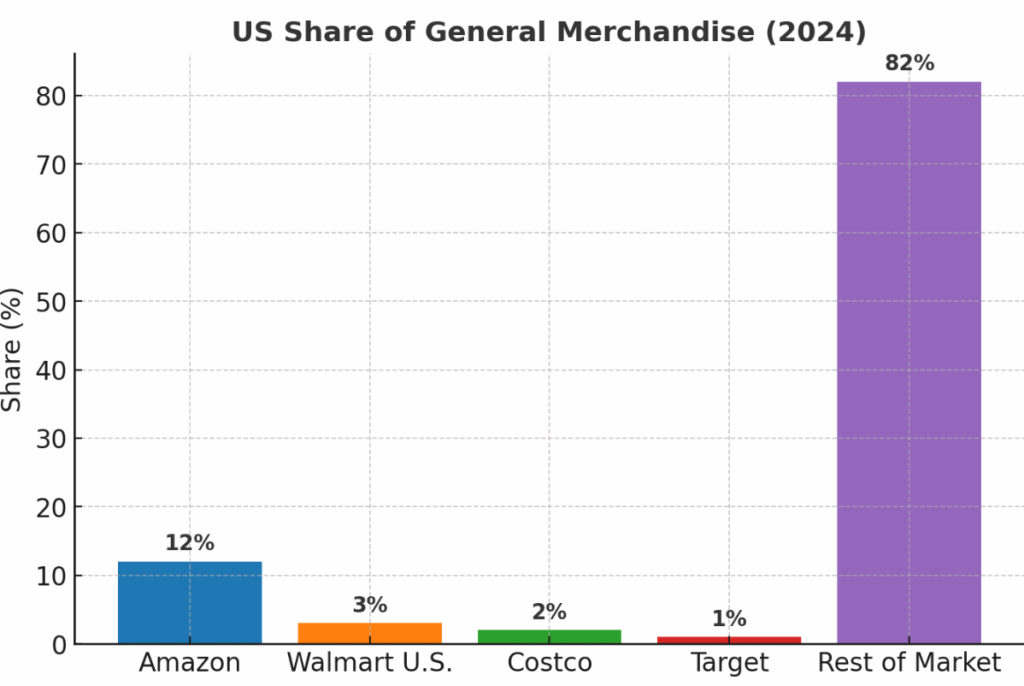
The competitive dynamic in general merchandise is intense. Walmart has about 3% share in general merchandise, yet the growth in its digital segment, which powers this category, stands out. Global e-commerce was up 25%, supported by advertising, and membership revenue growth.
As Walmart and Amazon add more products and e-commerce penetration continues, it will be harder for laggards to pivot. As displayed in the image, there is significant room for growth and share to be taken.
This is in contrast to TJX (T.J. Maxx) which posted another strong set of results, with double-digit growth, proving once again that bargain hunting on the high street is a growth strategy in tough times, that consumers value.
China Tech: Mixed Signals
Xiaomi delivered a standout performance: revenue up 30% year-on-year, with electric vehicle sales more than tripling. Affordable innovation — from smart devices to EVs — is capturing cautious Chinese households. The slide from their earnings presentation below shows the breadth of the business.

The Bigger Picture: Resilient, But Selective
- U.S. shoppers: Still spending, but with caution. Essentials and maintenance win out over big discretionary purchases.
- UK shoppers: Inflation pressures households, but Tesco’s success shows how value and quality together can drive share gains, as inflation spikes.
- China: Consumers are cautious, but willing to spend on affordable tech and autos. Baidu’s struggles highlight how fast digital habits are shifting.
The thread connecting all of this is technology. Retailers and platforms that use it to sharpen pricing, predict demand, and tailor the customer experience are creating structural advantages that go beyond this cycle.