


This week delivered the kind of market drama that often defines inflection points: violent price swings, the world’s largest company reporting blockbuster earnings, Bitcoin plummeting from recent highs, Japanese government bond yields surging to multi-year peaks as fiscal concerns mount, and—just to remind us that not everything is digital—the start of one of sport’s greatest rivalries, the Ashes cricket series between England and Australia. Against this backdrop of volatility and uncertainty, we’re seeing a series of strategic shifts across the consumer and technology landscape that reveal where power is concentrating, which business models are winning, and what it might mean for how one allocates capital in this environment. This week’s signals from Walmart, NVIDIA, Google, and the housing-linked home improvement giants aren’t isolated data points—they’re interconnected threads in a broader narrative about AI infrastructure, retail transformation, and the American consumer.
The Fortress at the Centre of Consumer America
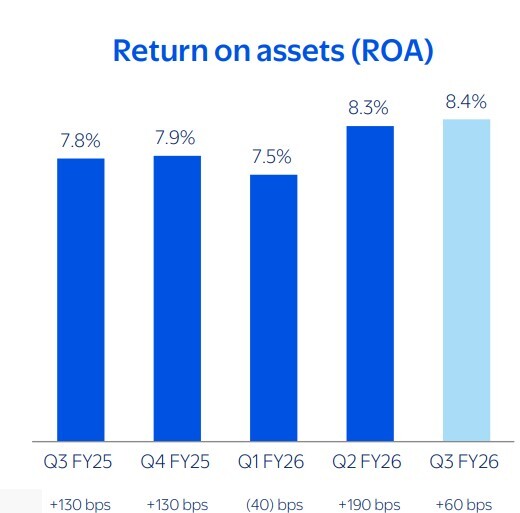
The most important signal from the U.S. consumer didn’t come from Nvidia, a member of the Federal Reserve, or even a Trump tweet—it came from Bentonville. Walmart’s Q3 numbers were strong on their own (5.8% global revenue growth, 27% surge in e-commerce, 31% ad growth, and share gains across grocery and general merchandise), but the real story was the company’s decision to shift its listing to the Nasdaq. At $850 billion in market cap, it’s the largest exchange transfer ever—a conscious step away from the NYSE’s “old economy” heritage toward the tech ecosystem that defined the “FAANG” era. This isn’t a cosmetic move. It’s the public declaration of Walmart’s metamorphosis from a recession-resilient discounter into a people-led, tech-powered retail platform.
The numbers now tell a very different story than they did a decade ago. AI-orchestrated supply chains and automated distribution centres now handle more than 60% of U.S. freight, enabling Walmart to flip global e-commerce into sustained profitability for the first time. Higher income households, far from “trading down,” are choosing Walmart deliberately for frictionless omnichannel convenience, wide assortment, and price clarity—while lower and middle income consumers stretch every dollar on essentials and skip discretionary aisles entirely. The bifurcation of the American shopper is no longer a forecast; it is a fact. And Walmart—270 million weekly visits deep—is the gravitational centre of that shift.
Why does this matter? Because Walmart is now the only retailer that can defend a 2–3% margin on $650 billion of low-ticket essentials while layering 20–40% incremental margins from advertising, membership, and fulfilment services on top. That combination creates an economic fortress at the very moment Amazon is being pressured by rising customer acquisition costs and competition from the likes of Temu and TikTok Shop. Physical stores are not relics in this world—they are the cheapest logistics grid on earth, now supercharged by AI to cut unit costs 10–15% and lock in loyalty through Walmart+ and Sam’s Club. As CFO John David Rainey put it, “Moving to Nasdaq aligns with the people-led, tech-powered approach to our long-term strategy.” The market got the message: this is the blueprint for AI-infused retail in a sub-2% real income growth environment.
The ripple effects extend far beyond Walmart’s aisles. Legacy grocers face a widening technological chasm with limited credible digital counteroffensive. Off-pricers such as TJX and Ross remain resilient but appear capped by square-footage growth and lack the data flywheel to monetize traffic. Pure-play e-commerce challengers are discovering the pain of rising acquisition costs in a privacy-first world. Meanwhile, consumer staples giants—from General Mills to Kimberly Clark are already dealing with mid-teens private label penetration driven by Member’s Mark, forcing the biggest margin reset in the CPG complex in a generation.
The broader trend is unmistakable: re-intermediation through ecosystem fortresses. Walmart+, Amazon Prime, and Costco aren’t loyalty programs—they are economic engines where recurring fees subsidize lower consumption costs in a low-growth era. It’s software-like compounding embedded within the consumer sector, and Walmart’s Nasdaq shift is the clearest sign yet that the old boundaries between “retail” and “tech” have collapsed. The companies that can wield data, automation, and physical scale simultaneously are increasingly redefining capital allocation and the impact on consumers.
Addressing the “AI Bubble”
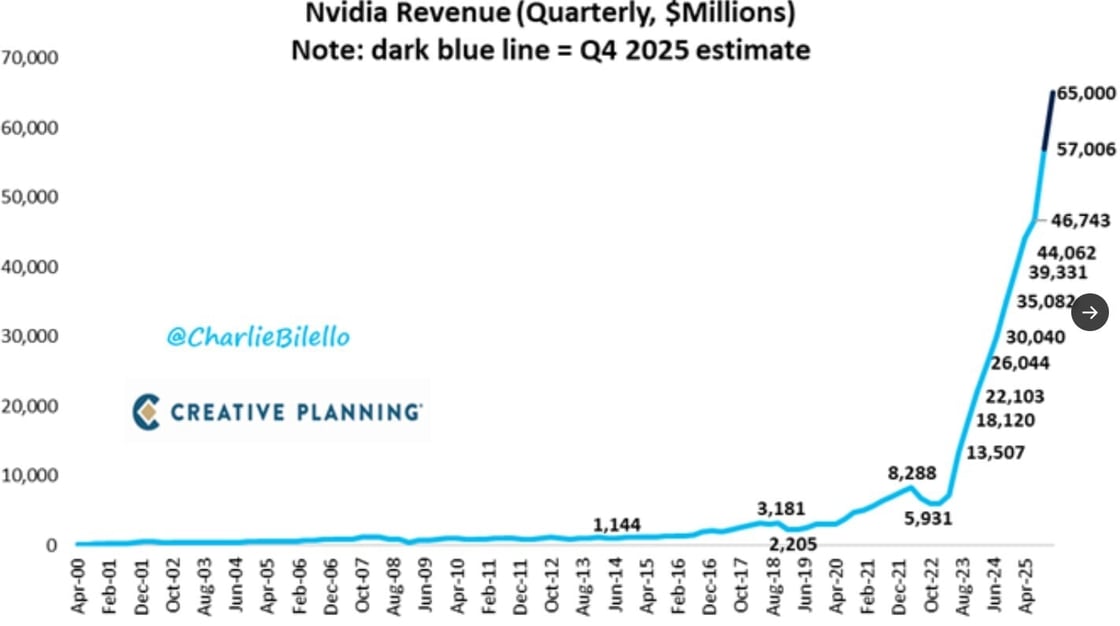
NVIDIA delivered blockbuster results this week, but the real story goes far beyond a single quarter’s performance. CEO Jensen Huang addressed the elephant in the room head-on: “There’s been a lot of talk about an AI bubble. From our vantage point, we see something very different.” Critics would argue, “what else would he say?!” However, Huang has been consistent over some time that what we’re witnessing isn’t speculative excess; it’s the simultaneous convergence of three fundamental platform shifts—from general purpose to accelerated computing, from traditional software to generative AI, and from virtual to physical AI through robotics and autonomous systems. CFO Colette Kress made the stakes crystal clear, stating the company has “visibility to $500 billion in Blackwell and Rubin revenue” through calendar 2026, with management estimating the total addressable market will reach $3-4 trillion in annual AI infrastructure spending by decade’s end. When Huang said “we’ve entered the virtuous cycle of AI,” describing how demand creates infrastructure which enables better AI which drives more demand, he was articulating the economic flywheel now spinning at unprecedented velocity.
The bubble debate fundamentally misframes the question in my view. Yes, NVIDIA faces legitimate risks—customer concentration (four clients represent 61% of sales, up from 56% in Q2), hyperscaler custom chip development, intensifying competition in inference workloads, China export controls eliminating what could be a $50 billion annual market, and innovation disruption. But these risks exist within a context where “demand for AI infrastructure continues to exceed our expectations,” as Kress noted, adding that “the clouds are sold out, and our GPU-installed base…is fully utilized.” The architectural transitions from NVIDIA platforms—Hopper to Blackwell to Rubin—demonstrate NVIDIA’s ability to maintain technological leadership through annual product cadences delivering 5-10x performance improvements while preserving backward compatibility with 3.5 million developers locked into its ecosystem.
More importantly, this AI infrastructure buildout isn’t happening in isolation—it’s enabling businesses across sectors to deploy capabilities that were impossible 24 months ago. When $400-450 billion flows into AI infrastructure in 2026 alone, and enterprises report measurable returns from AI adoption across operations, customer engagement, and decision-making, we’re watching capital allocation toward genuine productivity enhancement rather than speculative mania. We think those who are negative may be missing the forest for the trees. The question isn’t whether there’s a bubble; it’s whether companies—including those in your portfolio—are positioned to capture the productivity and competitive advantages this infrastructure enables, or risk falling behind competitors who are.
When Interfaces Become Intelligent
Google’s release of its latest AI model this week, Gemini 3, marks a pivotal shift: AI no longer returns text—it generates custom interfaces in real-time, cutting decision-making time by 40% and reshaping how consumers will likely interact with digital services. Rather than static product pages or text-heavy search results, imagine retail platforms generating personalized shopping interfaces, financial services creating bespoke dashboards on the fly, or travel apps building interactive itineraries tailored to your preferences and budget. The simultaneous launch of Google Antigravity—an agentic platform where AI autonomously orchestrates multi-step workflows—signals that the competitive advantage now belongs to companies reimagining experiences around AI-native interfaces, not those retrofitting AI into legacy products. This is at the epicentre of consumer interactions.
Gemini 3 makes possible generative UI (or generative interfaces) wherein large language models generate both content and entire user experiences, including web pages, games, tools, and applications that are “automatically designed and fully customized in response to any question, instruction, or prompt.” This work represents a first step toward fully AI-generated user experiences, where users automatically get dynamic interfaces tailored to their needs, rather than having to select from an existing catalogue of applications. Google’s full-stack dominance (models, TPUs, 2+ billion distribution channels) creates structural advantages, but the real opportunity for consumer-focused investors lies in identifying platforms and brands that leverage these capabilities to drive measurable improvements in engagement, conversion, and lifetime value that static UIs simply cannot deliver.
The Housing Market Hold
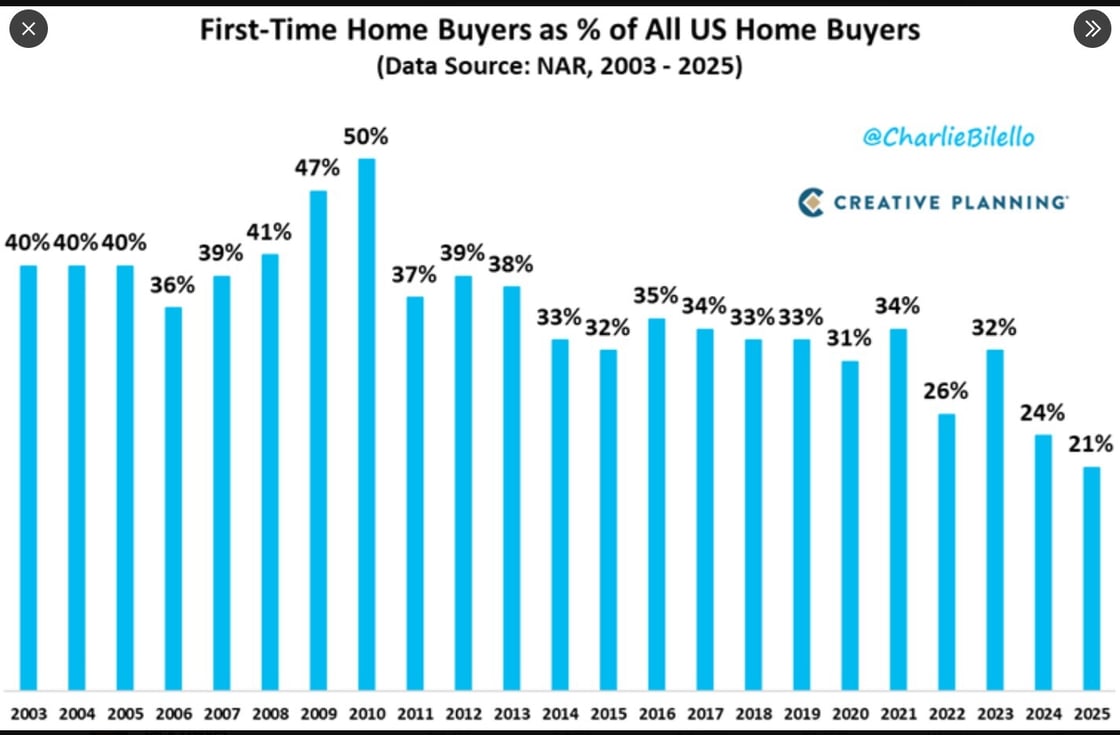
This week’s earnings from Lowe’s and Home Depot crystallized a critical theme we’ve been tracking: the American consumer isn’t weak—they’re frozen by the housing market, and the battleground for future market share is shifting decisively toward the professional contractor. Lowe’s outperformed with high single-digit Pro comp growth and margin expansion despite negative overall sales, while Home Depot stumbled with softer Pro performance and margin compression. But the more important signal isn’t the quarterly scorecards—it’s the strategic divergence these companies represent.
Both have deployed ~$25 billion combined on Pro-focused acquisitions (Lowe’s buying Foundation Building Materials for $8.8 billion, Home Depot acquiring SRS Distribution for $18.25 billion), effectively conceding that the DIY consumer is trapped in a housing turnover freeze at 30-year lows. With mortgage rates keeping homeowners locked into sub-3% pandemic-era financing, and home turnover at just 28 per 1,000 homes, the discretionary remodelling cycle that typically accompanies new home purchases has evaporated. The Pro customer, by contrast, represents non-discretionary maintenance and new construction—sticky, recurring revenue streams in a $250 billion addressable market. Both CEOs acknowledged they cannot predict when housing will inflect, but the frozen market is now the binding constraint on consumer discretionary spending across home improvement, appliances, furniture, fixtures, and the broader goods economy.
The strategic moats both retailers are building—distribution networks reaching 1,100+ combined locations, AI-powered tools like Lowe’s Mylow Companion (driving 200 basis point customer satisfaction gains), trade credit platforms managing 130,000+ Pro accounts, and integrated project management ecosystems—create nearly insurmountable barriers to entry requiring tens of billions in capital and decades to replicate. This infrastructure matters because whenever the housing market unfreezes, the company with the most robust Pro ecosystem will capture disproportionate share in the recovery.
Management teams are preparing for eventual normalization: lower interest rates in 2026 could drive mortgage rates to 5.5-5.75% for the first time since 2022, potentially catalysing both turnover and renovation activity after three years of stagnation. The $17.6 trillion in housing wealth sitting idle represents an enormous pent-up demand backlog—homeowners are deferring maintenance, skipping kitchen renovations, and postponing discretionary projects at rates not seen since the 2008 financial crisis. For investors, the timing question is critical: when will this dam break? The home improvement story is fundamentally a housing story; until mortgage rates move materially lower and housing turnover normalises, discretionary goods spending will remain suppressed regardless of broader economic strength. Yet, when it does normalize, the winners that built fortress-like Pro ecosystems during the downturn—will likely be well positioned.
Hit for Six
Meanwhile, on the sporting front, England and Australia commenced their storied Ashes cricket rivalry in Perth—a contest that, like the markets, hinges on strategy, execution under pressure, and the ability to adapt when conditions shift. England seeks to win in Australia for the first time in 15 years, while Australia aims to retain the urn it has held for nearly a decade. The parallel is apt: in both sport and investing, success belongs to those who combine preparation, discipline, and the courage to execute when everyone else is paralyzed by uncertainty. It can be fast, unexpected and disruption creates opportunities.
This week has underscored a theme we have been expressing: we’re in the midst of a multi-year transition where we believe that AI infrastructure spending reshapes competitive dynamics, where retail winners separate from losers based on their ability to merge physical scale with digital intelligence, and where consumer spending patterns reveal not weakness but structural shifts driven by housing market paralysis and income bifurcation. The volatility we’re experiencing is not uncommon and we must remember the famous line from Ben Graham that “in the short term the market is a voting machine, yet in the long term, it is a weighing machine.” As we navigate these crosscurrents, our focus remains on identifying the fortress businesses building unassailable moats, the infrastructure beneficiaries capturing AI spending, and the companies positioned to capitalize when frozen markets eventually thaw.
Please contact a member of the Team to discuss further. To add a colleague or peer to the note, use the sign up form below.
What an exciting time to be alive!